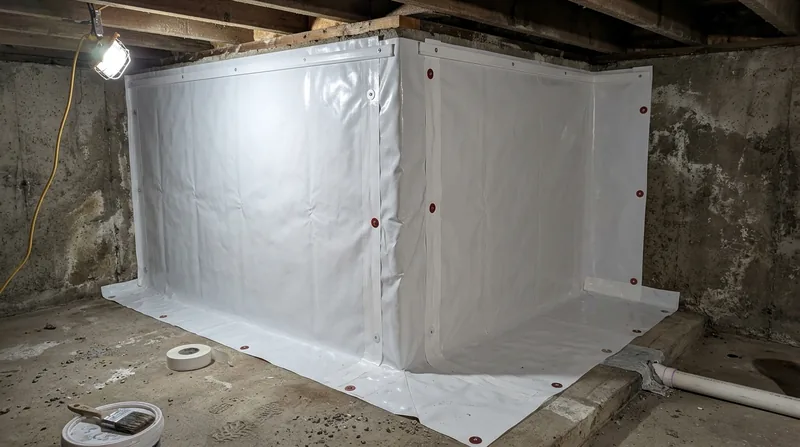




Vapor Barrier Installation in Lowell: Sealing Out Ground Moisture at the Source
If you own a home in Lowell, you already know the basement tells the story of the soil. The mill-era triple-deckers in the Acre and Centralville, the brick and frame workers' housing in Belvidere and Pawtucketville, and the 1900s two-families in the Highlands all sit on fieldstone, brick, or early block walls that were never designed to stop vapor. When we install a vapor barrier installation in Lowell, we are not chasing a cosmetic dampness problem. We are stopping the continuous movement of ground moisture vapor through the wall and slab, the kind that leaves efflorescence on the brick and a musty smell in the stairwell all summer.
The ground here is glacial till and river outwash sand and gravel along the Merrimack and Concord, with a high water table in the floodplain and schist and granite bedrock close to the surface on the hills. That combination pushes moisture vapor into the lower level year-round, and the freeze-thaw cycle works every crack open a little wider each winter. A properly installed barrier, with sealed seams and taped terminations, is the difference between a basement you can use and one you avoid. For the full picture of how this fits with drainage and wall sealing, start with our basement waterproofing service.
Why Vapor Barrier Installation Matters in Lowell's Older Basements
Most of the housing stock in Lowell was built before anyone thought about below-grade moisture control. The fieldstone and early block walls in the Acre and Centralville are porous by nature, and the old clay footing drains that once carried water away are now collapsed or root-filled. When the water table rises in spring, hydrostatic pressure pushes vapor through the mortar joints and the slab, not just liquid water. That is why a coat of paint on the wall never holds.
- A vapor barrier stops ground moisture vapor from passing through the wall and slab into the basement air.
- Sealed seams and taped terminations keep the barrier continuous at corners, rim areas, and penetrations.
- Integration with the sump basin and interior perimeter drain keeps the barrier from trapping water behind it.
- Dimple board or a drainage mat behind the barrier gives any liquid water a path down to the drain tile.
- Proper termination at the slab edge and wall top prevents the barrier from peeling or wicking moisture.
In the Highlands and South Lowell, where the 1900s two-families have full basements with brick walls, we often find efflorescence and a musty smell that the homeowner has tried to solve with dehumidifiers alone. The barrier addresses the source. For properties where the wall itself is failing, foundation crack repair comes first, then the barrier.
Key info: On a triple-decker in Centralville with a fieldstone wall and a high water table, we routinely find that the wall is wet from vapor drive, not from a single crack. A vapor barrier with sealed seams and a dimple mat behind it is the right fix there, not another coat of masonry sealer.
For the official word on building permits and inspection requirements in Lowell, the city's inspectional services department is the authority, and rules vary by jurisdiction. You can review the city's permit information at lowellma.gov before any work begins.
How We Install a Vapor Barrier in a Lowell Basement
We start by walking the basement and grading the source of the moisture. A wet wall after rain, efflorescence, and a musty smell point to vapor drive and hydrostatic pressure, while a single wet spot points to a crack or a failed footing drain. The installation sequence below is what we follow on a typical Lowell full basement, whether it is a poured 1980s foundation on the city's edge or a brick wall in Pawtucketville.
- We inspect the wall and slab, note crack locations, and confirm whether an interior drain tile system is needed before the barrier goes up.
- We clear the perimeter, remove any failing parging, and address active cracks with epoxy or polyurethane injection where required.
- We install dimple board or a drainage mat against the wall so liquid water can reach the drain tile.
- We hang heavy-duty vapor barrier sheets from the top of the wall to the slab, overlapping seams by at least 6 inches.
- We seal seams with compatible tape or adhesive and tape all terminations at the rim, corners, and penetrations.
- We integrate the barrier with the sump basin and interior perimeter drain so water behind the barrier has a path out.
- We test the sump pump and check valve, then walk the job with you before we leave.
The order matters. A barrier installed over a wet wall without a drainage path traps moisture and makes the problem worse, which is why we treat the interior drain tile system as the foundation of the job when hydrostatic pressure is present.
Key info: On a 1920s two-family in the Highlands, the slab was damp across the whole floor and the brick wall showed white efflorescence. We installed an interior perimeter drain, integrated the sump basin, then hung a sealed vapor barrier with a dimple mat behind it. The basement stayed dry through the next spring snowmelt.
Vapor Barrier Methods We Use in Lowell
Not every basement needs the same approach. The table below shows the methods we use and where each one fits in Lowell's housing stock and soil conditions.
| Approach | Description | Best for |
|---|---|---|
| Wall-hung vapor barrier with dimple mat | Heavy-duty sheet hung from rim to slab, sealed seams, dimple board behind it to drain liquid water. | Fieldstone and brick walls in the Acre and Centralville with vapor drive and a high water table. |
| Slab-edge sealed barrier | Barrier terminated and taped at the slab edge, integrated with the interior perimeter drain. | Poured basements in 1980s and 2000s subdivisions where the slab is damp but the wall is sound. |
| Sump-integrated barrier | Barrier tied into the sump basin and check valve so water behind the sheet reaches the pump. | Basements with an existing or new sump pump and a history of water after rain. |
| Barrier over injection-repaired cracks | Epoxy or polyurethane injection first, then the barrier over the repaired wall. | Brick and block walls in South Lowell with active seepage at the mortar joints. |
Each method is chosen after an on-site look at the wall, the slab, and the drainage. We do not sell a barrier where a simple crack seal is enough, and we do not seal a wall that needs drainage first.
Vapor Barrier Installation Cost in Lowell: What to Expect
Pricing for a vapor barrier in Lowell starts from $3/sq ft for the barrier and standard installation, and the final number depends on the wall condition, the square footage, and whether drainage work is needed first. A damp poured wall in a 1990s subdivision on the city's edge is a different job from a fieldstone wall in Belvidere that needs parging repair and a dimple mat. We give you a written scope before any work starts so you know what is included.
- Wall condition and height drive the labor, since fieldstone and brick walls take more time to prep than poured concrete.
- Seam and termination count rises with corners, penetrations, and rim areas, which adds time and material.
- Drainage work, such as an interior perimeter drain or sump integration, is priced separately when it is needed.
- Access matters in triple-deckers, where carrying materials through a narrow stairwell takes longer.
- Getting two or three estimates is smart, and we recommend comparing scope, not just the bottom line.
For a fuller breakdown of how we price basement work, see our pricing overview. The estimate is free, and we will tell you plainly if a barrier alone will not solve the problem.
Vapor Barrier Installation Near Me: Hiring a Waterproofing Contractor Near Lowell
When you search for vapor barrier installation near me in Lowell, you will find general foundation firms, plumbers, and dedicated waterproofing specialists. The difference shows up in the diagnosis. A dedicated specialist will tell you when simple crack sealing is enough and when hydrostatic pressure means you need drainage before a barrier. Here is what to check before you hire.
- Confirm the contractor is licensed and insured, and ask for a certificate of insurance before work begins.
- Get more than one estimate and compare the scope line by line, not just the total.
- Ask for local references from jobs in Lowell or nearby cities like Lawrence, Methuen, or Andover.
- Ask who pulls the permit when the work touches structural repair or drainage, since rules vary by jurisdiction.
- Check for a written transferable warranty and read what it actually covers.
To schedule a free basement inspection, reach us through our contact page or call (978) 788-0721. We serve Lowell and the surrounding cities, including Haverhill, Woburn, and Reading.
Vapor Barrier Installation in Lowell: Pricing Guide
| Service | Price | Details |
|---|---|---|
| Wall-hung vapor barrier with dimple mat | Starting at $3/sq ft | Includes heavy-duty sheet, dimple mat, sealed seams, and taped terminations on a standard basement wall. |
| Slab-edge sealed barrier | Starting at $3.50/sq ft | Includes slab-edge termination, taped seams, and integration with an existing interior perimeter drain. |
| Sump-integrated barrier | Starting at $4/sq ft | Includes barrier tie-in to the sump basin and check valve, with a pump test at the end of the job. |
| Barrier over injection-repaired cracks | On estimate | Requires an on-site look at crack activity and wall condition before a number is given. |
| Travel | Included | In Lowell and surrounding areas, no separate call-out or mileage fee. |
| Estimate | Free | Response within 24h at (978) 788-0721, no obligation to book. |
Indicative pricing, the exact cost depends on square footage, finish, and site access. Free personalized estimate within 24h at (978) 788-0721.


