



Foundation Crack Repair in Lowell
When a hairline crack in a fieldstone or poured concrete wall starts weeping after a nor'easter, Lowell homeowners need foundation crack repair in Lowell that matches the wall they actually have, not a one-size-fits-all patch. Lowell sits on glacial till and river outwash sand and gravel where the Merrimack and Concord rivers meet, and the water table in the floodplain stays high all spring. The Acre, Centralville, and Belvidere neighborhoods are packed with 1840s to 1900s brick and frame mill-era workers' housing and triple-deckers, most with full basements on fieldstone, brick, or early block walls. The Highlands and South Lowell hold 1900s to 1930s two-families with poured and block basements, and the outer streets carry 1950s to 1970s Cape Cods and ranches. Every one of those walls takes a freeze-thaw beating each winter, and cracks open a little wider every year. We inspect the crack, find out whether it is shrinkage, settling, or hydrostatic pressure, and then match it to epoxy injection, polyurethane injection, or a structural repair. If you want the full picture of how water moves through your basement, start with our basement waterproofing service.
Why Foundation Cracks Open So Fast in Lowell's Older Walls
The dominant failure mode in Lowell is not settling alone. It is hydrostatic pressure from a high water table pushing against walls that were never designed for it, combined with a freeze-thaw cycle that works every crack open and shut each year. Fieldstone and early brick walls in the Acre and Centralville were laid with lime mortar that softens as it stays wet, and the old clay footing drains under those houses are often collapsed or root-filled. Water backs up at the footing, finds the weakest point, and shows up as a vertical or stair-step crack. When you see white powder on the wall, that is efflorescence, and it means water is moving through the masonry right now.
- Vertical cracks usually come from concrete shrinkage and are the best candidates for epoxy injection.
- Stair-step cracks in block or brick walls point to settling or frost movement and need a structural look.
- Horizontal cracks near the middle of the wall signal a bowing wall under soil pressure, not a simple leak.
- Water that only appears after heavy rain or snowmelt usually means the footing drain is failing, not just the crack.
- Cracks that widen year over year tell you the freeze-thaw cycle is still active and a patch alone will not hold.
Sorting those five patterns before anyone touches a caulk gun is the difference between a repair that lasts and one that reopens by the next March.
Key info: On a 1920s two-family off Pawtucket Street, a stair-step crack in the block wall was not a crack problem at all. The old clay footing drain had collapsed, water stood against the wall, and the crack was the symptom. We repaired the crack and corrected the drainage, and the wall has stayed dry through two spring thaws.
Massachusetts does not license home improvement contractors through a single state board the way some states do, so the practical check is the local building department and the contractor's own registration and insurance. The City of Lowell building department is the authority on what permits your specific repair needs, and rules vary by jurisdiction.
How We Diagnose and Repair a Crack in a Lowell Basement
We start below grade and stay below grade. The first step is reading the wall: the crack direction, the width, the moisture pattern, and the condition of the mortar or concrete around it. Then we check what is happening at the footing, because a crack that stays wet after rain is usually being fed from outside. Only after that do we pick a method. A tight, dry vertical crack in a poured wall in South Lowell gets epoxy injection. A wet, active crack in a fieldstone wall in the Acre may get polyurethane injection because it foams and fills while water is still moving. A wall that is actually bowing goes to carbon fiber straps or wall anchors, which is a different job.
- We walk the basement and map every crack, damp patch, and efflorescence line.
- We test whether the crack is active by checking moisture after a rain or with a meter.
- We inspect the footing drain condition and the grading and downspout extensions outside.
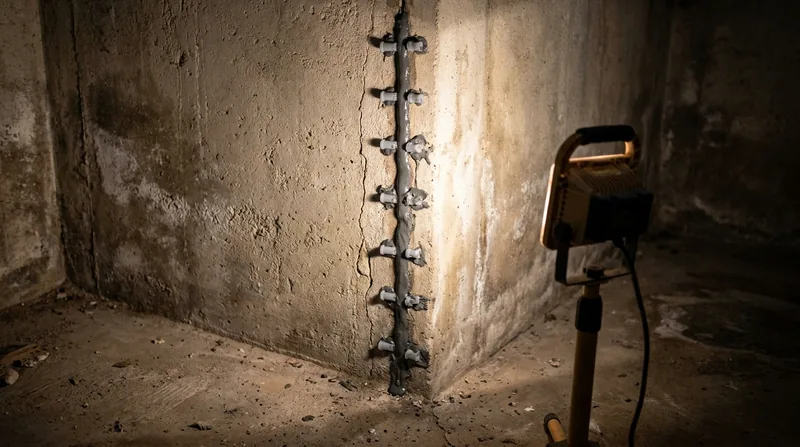
- We set injection ports along the crack and seal the surface before injecting.
- We inject epoxy or polyurethane under pressure until the material reaches the far side of the wall.
- We cut the ports flush, finish the surface, and note any crack that needs structural monitoring.
If the inspection shows the crack is only one part of a wet basement, we say so plainly, and we point you to the right scope instead of selling an injection you do not need. For walls that are moving rather than just leaking, our bowing wall repair page covers the structural side.
Key info: A ranch on the outer streets of Pawtucketville had a clean vertical crack in a poured wall, dry to the touch except after a hard rain. Epoxy injection closed it in a single visit. A triple-decker in Centralville had the same-looking crack, but the water was coming from a failed footing drain, so injection alone would have failed by spring. Same symptom, two different answers.
Crack Repair Methods We Use and When Each One Fits
There is no single correct repair for every crack, and any contractor who says otherwise is selling a product, not a diagnosis. The table below shows how we match the method to the wall and the water. The deciding factors are crack width, whether the crack is active, the wall material, and whether the wall is moving.
| Approach | Description | Best for |
|---|---|---|
| Epoxy injection | Structural epoxy is pumped into ports along the crack and bonds the concrete back together. | Dry, tight vertical cracks in poured walls, common in South Lowell and the newer subdivisions. |
| Polyurethane injection | Flexible foam expands and cures in contact with water, sealing active leaks. | Wet, active cracks and fieldstone or brick walls in the Acre and Centralville. |
| Surface sealing and parging | Hydraulic cement or masonry patch over the crack, then a parging coat. | Minor seepage and cosmetic repair where the wall is not moving. |
| Carbon fiber straps | Straps bonded to the wall resist inward movement across a crack. | Bowing block walls with horizontal or stair-step cracking. |
| Wall anchors | Anchors driven into the soil outside pull the wall back toward plumb. | Walls that have moved and need realignment, not just sealing. |
| Drainage correction | Interior perimeter drain or footing drain repair relieves pressure behind the wall. | Cracks that stay wet because water is trapped at the footing. |
In most Lowell basements the honest answer is a combination: seal the crack, then fix the water that opened it. If the crack is the only problem, we say so and stop there.
Foundation Crack Repair Cost in Lowell: What to Expect
Foundation crack repair pricing starts at $450 for a single, accessible, non-structural crack with straightforward injection. That figure is a starting point, not a ceiling, and it reflects the reality that most Lowell jobs are not a single clean crack. The biggest cost drivers are crack length and width, whether the crack is active, the wall material (fieldstone and brick take longer than poured concrete), and whether the repair needs a structural component like straps or anchors. Access matters too: a basement packed with stored belongings or a wall behind a finished surface adds labor.
Here is the part most homeowners do not hear. If the crack is a symptom of a failed footing drain or hydrostatic pressure, sealing it alone is money spent twice, because it will reopen. We tell you when a simple injection is genuinely enough and when the real fix is drainage. That is why we recommend getting two or three estimates and asking each contractor what they found at the footing, not just what they will charge for the crack. Our full pricing overview breaks down what moves the number up or down.
Costs also vary with urgency. A crack that is actively leaking during a spring thaw in the river floodplain gets scheduled faster than a dry hairline crack found during a routine inspection. Neither one is an emergency in most cases, but a leaking crack in a finished basement does more damage the longer it runs.
Foundation Crack Repair Near Me: How to Choose a Contractor Near Lowell
Hiring the right contractor near Lowell comes down to a few checks that take about ten minutes and save a lot of grief. The first is licensed and insured status. Ask for the certificate of insurance and confirm the coverage is current, not just that the truck says insured. The second is whether the contractor diagnoses before quoting. Anyone who quotes a crack repair over the phone without seeing the wall is guessing. The third is references from basements like yours, meaning older fieldstone or block walls, not just new poured concrete.
Permits matter for structural work. If the repair involves carbon fiber straps, wall anchors, or cutting the foundation, the City of Lowell building department may require a permit, and the thresholds vary by jurisdiction, so verify before work starts. Ask the contractor who pulls the permit and who is responsible for inspection. Get the scope in writing, including whether the price covers the injection, the surface finish, and any drainage correction. A written scope is what protects you if the crack reopens.
Finally, ask what happens if the crack leaks again. A reputable contractor offers a transferable warranty, in writing, and explains exactly what it covers. If you want to talk through your basement before you commit to anything, contact us for a free estimate and we will tell you what the wall is actually doing.
Foundation Crack Repair in Lowell: Pricing Guide
| Service | Price | Details |
|---|---|---|
| Single non-structural crack, epoxy or polyurethane injection | Starting at $450 | Covers one accessible crack up to about 8 feet, ports, injection, and surface finish |
| Multiple cracks in the same basement | Starting at $750 | Priced per crack after the first; fieldstone and brick walls take longer than poured |
| Active leaking crack with drainage correction | On estimate | Needs an on-site look to determine whether the footing drain or hydrostatic pressure is feeding it |
| Structural repair with carbon fiber straps or wall anchors | On estimate | Bowing or moved walls require engineering review and a permit in most cases |
| Travel | Included | in Lowell and surrounding areas, no separate call-out or mileage fee |
| Estimate | Free | Response within 24h at (978) 788-0721, no obligation to book |
Indicative pricing, the exact cost depends on square footage, finish, and site access. Free personalized estimate within 24h at (978) 788-0721.


