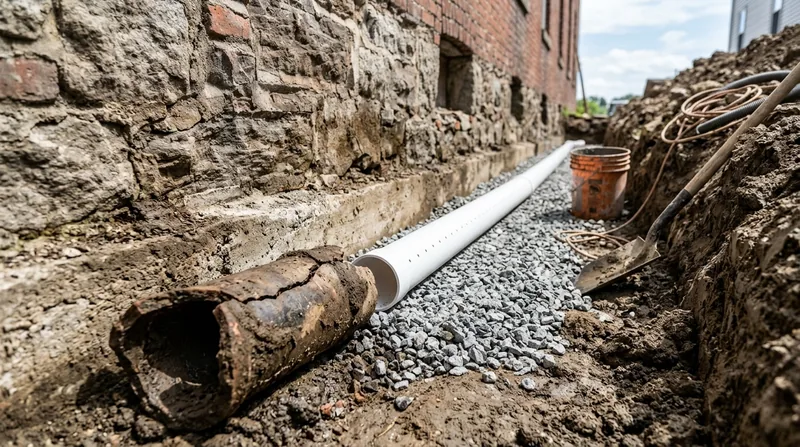




Lowell sits where the Merrimack and Concord rivers meet, and that geography has shaped every basement in the city. The Acre, Centralville, Belvidere, and Pawtucketville are packed with 1840s to 1900s brick and frame mill-era workers' housing and triple-deckers, most sitting on fieldstone, brick, or early block foundations with original clay footing drains. Drain Tile Repair & Replacement in Lowell is the work of restoring those buried lines before spring snowmelt and nor'easter rain push water through walls that were never meant to hold back a rising water table. The ground here is glacial till and river outwash sand and gravel, with schist and granite close to the surface on the hills and a high water table in the floodplain, so a failed drain tile has nowhere to send the water. We camera the line, find the break, and replace it with modern PVC. If you are already seeing water at the wall base, start with a basement waterproofing assessment so the drain and the wall are read together.
Why Drain Tile Repair Matters in Lowell's Mill-Era and Riverfront Basements
The dominant failure mode in Lowell is not a single dramatic crack. It is a 100-year-old clay footing drain that has silted up, shifted, or been found by the roots of the elms and maples that line the older lots. When that line stops moving water, hydrostatic pressure builds under the slab and against the footing, and the basement tells you about it at the wall base and floor joint. In the Highlands and South Lowell, the 1900s to 1930s two-families and bungalows have the same problem in a slightly newer package: full basements, shallow footings, and drains that were never designed for today's runoff volume.
- Water seeps at the wall base and floor joint after every heavy rain because the footing drain is no longer carrying it away.
- Efflorescence and white mineral bloom appear on brick and block walls as moisture moves through the masonry.
- The sump basin runs constantly or the pump cycles on and off because groundwater is arriving faster than the old tile can handle.
- Soft spots, settled slabs, and standing water appear near the floor drain or along the interior perimeter.
- Tree roots from mature street trees enter the line at the joints and slowly close the pipe.
Each of these points to the same below-grade problem, and each gets worse with every freeze-thaw cycle until the line is repaired or replaced.
Key info: A Belvidere triple-decker with a fieldstone foundation and a 1920s clay footing drain will often show water at the wall base in April, not because the wall failed, but because the drain line is root-bound and silted. Camera inspection tells you which one it is before anyone quotes excavation.
For the official local picture on permits and property records, start with the City of Lowell municipal offices, and verify current requirements with the building department before any work that alters drainage.
How We Repair and Replace Drain Tile in Lowell, Step by Step
We do not start with a shovel. We start with a camera and a plan, because in Lowell the difference between a targeted repair and a full perimeter replacement is usually visible only inside the pipe. A line that is collapsed in one 10-foot run is a repair. A line that is root-bound and silted from end to end is a replacement, and the two carry very different scopes.
- We walk the basement, map the visible water patterns, and locate the sump basin, cleanouts, and any existing interior perimeter drain.
- We run a camera through the footing drain to find collapses, root intrusions, offset joints, and silt buildup.
- We mark the excavation limits and confirm access for equipment, which matters on tight lots in Centralville and the Acre.
- We excavate to the footing, remove the failed clay or collapsed section, and inspect the footing and wall base while it is open.
- We install new perforated PVC drain tile on a washed stone bed with filter fabric, and tie it into the sump basin or discharge point.
- We backfill in lifts, restore grading so surface water runs away from the wall, and test the line before we leave.
Every repair ends with a flow test, not a handshake, so you see the water leaving the line before the crew packs up.
Key info: On a 1920s two-family in the Highlands, we found a clay line collapsed under a concrete walk and root-bound at two joints. A targeted replacement of 22 feet and a new sump connection solved it, without touching the rest of the perimeter. On a Pawtucketville lot with river outwash sand, the same symptoms came from a silted line end to end, and the honest answer there was full replacement.
When the camera shows the drain is sound but the wall is still wet, the better answer is often an interior drain tile system that manages water at the wall base rather than chasing the old exterior line.
Drain Tile Repair Options We Use in Lowell
Not every failed line needs the same treatment, and the right approach depends on where the break is, how much of the line is compromised, and what the site allows. The table below shows the options we weigh on a typical Lowell property.
| Approach | Description | Best for |
|---|---|---|
| Targeted exterior repair | Excavate and replace a failed section of footing drain, then tie back into the existing line. | A single collapse or root intrusion on an otherwise sound clay line. |
| Full exterior replacement | Remove the old clay tile end to end and install new perforated PVC on washed stone. | Silted, root-bound, or offset lines on 1880s to 1930s foundations. |
| Interior perimeter drain | Cut a channel at the wall base, install drain tile to a sump basin, and manage water from inside. | Walls that stay wet after rain even when the exterior line tests clear. |
| Sump and discharge upgrade | New sump basin, pump, check valve, and discharge line to move collected water out and away. | A working drain that overwhelms an undersized or aging pump. |
| Camera-only diagnosis | Inspect and map the line before committing to excavation, with findings explained on site. | Homeowners who need to know whether repair or replacement is honest. |
We recommend the smallest scope that actually solves the water problem, and we say so when the camera shows the line is fine.
Drain Tile Repair & Replacement Cost in Lowell: What to Expect
Pricing starts at $750 for a camera inspection and a targeted repair on an accessible line, and rises from there based on what the camera finds. The biggest cost driver is scope: a 10-foot repair at a single collapsed joint is a different job from a full perimeter replacement around a fieldstone foundation in Belvidere. Access is the second driver, because tight side yards in Centralville and the Acre mean hand excavation where a machine cannot reach.
- Length of line replaced and whether the old clay tile must come out entirely.
- Depth to the footing, which varies with the grade and the age of the house.
- Access for equipment, including fences, walks, porches, and mature trees on older lots.
- Whether the sump basin, pump, check valve, or discharge line also needs upgrading.
- Restoration of grading, walks, and any concrete that has to be opened and replaced.
Get two or three written estimates with the camera findings attached, and compare scope line by line rather than the bottom number alone. Our full pricing overview lays out the ranges we work from.
What to Look For When Hiring a Drain Tile Contractor Near Me in Lowell
Drain tile work is below grade and largely invisible once the backfill goes in, so the vetting happens before the contract, not after. Ask for proof of licensing and insurance, and expect a certificate of coverage on request. Ask whether the company runs a camera before quoting, because anyone who quotes a replacement without looking inside the line is guessing.
- Confirm the contractor is licensed and insured, and get the certificate before work starts.
- Get two or three written estimates that describe scope, materials, and restoration in plain terms.
- Ask for local references from jobs in Lowell or the surrounding towns, and call them.
- Ask who pulls any required permit and how the work is inspected, since drainage changes and sump discharge connections can require one.
- Get the warranty terms in writing and confirm whether it is transferable.
If a quote sounds too low for the scope, ask what is excluded, because restoration and disposal are where shortcuts hide. Reach out through our contact page to schedule a look at your line.
Drain Tile Repair & Replacement in Lowell: Pricing Guide
| Service | Price | Details |
|---|---|---|
| Camera inspection and targeted repair | Starting at $750 | Includes camera inspection and a short accessible repair; depth and access move the price. |
| Sectional drain tile replacement | Starting at $2,400 | Replaces a failed run of clay tile with PVC; length and excavation access drive cost. |
| Full perimeter footing drain replacement | On estimate | Needs an on-site look at depth, access, foundation type, and restoration before pricing. |
| Sump basin and discharge upgrade | Starting at $1,150 | New basin, pump, check valve, and discharge line; pump capacity and routing affect price. |
| Travel | Included | In Lowell and surrounding areas, no separate call-out or mileage fee. |
| Estimate | Free | Response within 24h at (978) 788-0721, no obligation to book. |
Indicative pricing, the exact cost depends on square footage, finish, and site access. Free personalized estimate within 24h at (978) 788-0721.


