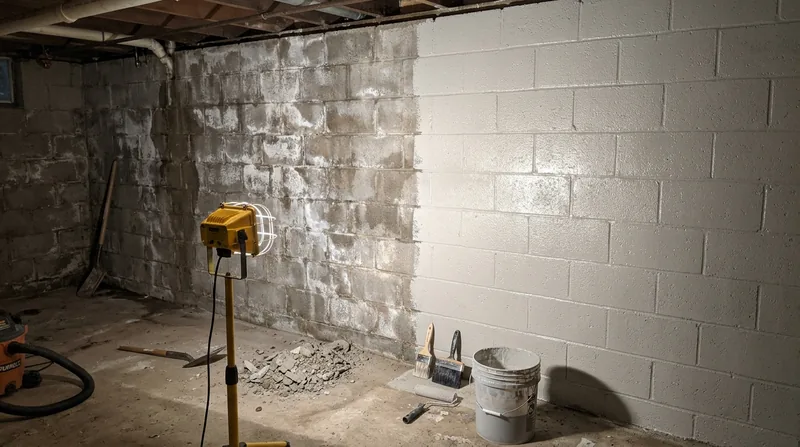




Lowell sits where the Merrimack and Concord rivers meet, on glacial till and river outwash sand and gravel, with schist and granite bedrock close to the surface on the hills. That geology matters below grade: the Acre, Centralville, Belvidere and Pawtucketville are full of 1840s to 1900s brick and frame mill-era workers' housing and triple-deckers, most of them on fieldstone, brick or early block foundations with old clay footing drains that have been quietly failing for decades. Basement Wall Sealing in Lowell starts with one honest question: is the wall just damp, or is water pushing through it under hydrostatic pressure? We answer that before we sell anything. If a penetrating sealer will fix it, we say so. If the real problem is a high water table in the river floodplain, spring snowmelt and nor'easter rain driving water at those older walls, we tell you that too, and point you to the right fix. Call (978) 788-0721 to book a free inspection, or start with our basement waterproofing service page.
Why Basement Wall Sealing Matters in Lowell's Mill-Era and Riverfront Housing
Most of the seepage calls we get in Lowell come from walls that were never meant to hold back a wet hillside. Fieldstone and soft brick foundations in the Acre and Centralville wick moisture, efflorescence blooms white on the mortar, and the wall feels cold and damp long after a storm passes. Along the Merrimack floodplain the water table stays high, so the wall is wet from the outside in, not from a leak you can caulk. Sealing is the right tool for surface dampness and minor seepage, and the wrong tool for a wall under pressure.
- Efflorescence and white salt staining tell you water is moving through the masonry, not just condensing on it.
- Damp patches that spread after rain point to porous brick or block that a breathable sealer can help.
- Water at the wall-floor joint usually means the footing drain is gone, and sealing alone will not stop it.
- Bowing or horizontal cracks mean pressure, and that is a structural conversation, not a sealer job.
- Freeze-thaw winters work every hairline crack open a little wider each year, so small issues do not stay small.
We would rather tell you a $1,500 sealing job is not your answer than take the money and watch the wall weep again next March.
Key info: On a brick triple-decker off Broadway in Centralville, the owner had efflorescence and a damp wall but no standing water. A penetrating sealer after proper prep solved it. Two streets over, a fieldstone wall in the Acre was wet at the floor joint every spring, and that one needed an interior perimeter drain, not a sealer. Same city, different problem.
Massachusetts homeowners can verify contractor registration through the Office of Consumer Affairs and Business Regulation, and Lowell building permits run through the city's inspectional services department.
How We Seal Basement Walls in Lowell, Step by Step
Sealing a basement wall is mostly preparation. If you paint a sealer over efflorescence, over a chalky parging coat, or over a damp wall, it peels within a season and you have wasted the money. We start by diagnosing why the wall is wet, then prep the surface properly before anything goes on. On poured walls in the 1980s and 2000s subdivisions on the city's edges, that prep is different from what an 1890s brick wall in Pawtucketville needs.
- We walk the basement and the exterior grade, checking downspout extension, grading, and any sign of hydrostatic pressure at the wall-floor joint.
- We test the wall for moisture and map where the dampness is coming from, surface condensation or actual seepage.
- We remove efflorescence, loose parging and old failing coatings so the sealer bonds to sound masonry.
- We fill cracks and voids with the right material, hydraulic cement or epoxy injection depending on the crack.
- We apply a penetrating sealer on porous masonry or a membrane sealer where the wall needs a film, matched to the wall type.
- We tell you plainly if the wall needs more than sealing, and what that would involve.
If the inspection shows the wall is wet from pressure rather than surface dampness, we will point you toward an interior drain tile system instead of taking a sealing job that will not hold.
Key info: A 1950s Cape on the outer streets of South Lowell had a poured wall with condensation dampness and no water on the floor. Sealer and a downspout extension fixed it. A 1920s two-family in the Highlands had the same complaint but water at the cove joint after every nor'easter, and that one got a drain, not a sealer.
Sealing Approaches We Use on Lowell Basement Walls
Not every wall takes the same product. Fieldstone and old brick breathe differently than poured concrete, and a film-forming sealer on a wall that needs to dry outward can trap moisture and make things worse. We match the approach to the wall we find.
| Approach | Description | Best for |
|---|---|---|
| Penetrating sealer | Soaks into porous masonry and blocks water absorption without a surface film. | Damp brick, block and fieldstone walls with no standing water. |
| Membrane sealer | Forms a flexible coating on the wall face to stop surface seepage. | Poured walls with minor seepage and sound, dry surface. |
| Crack injection | Epoxy or polyurethane injected through ports to close active cracks. | Isolated vertical or hairline cracks in poured foundations. |
| Parging repair | Replaces failed mortar coating on old masonry before sealing. | Crumbling brick and fieldstone walls in mill-era homes. |
| Diagnostic first | Moisture testing and grade review before any product goes on. | Any wall where the cause of dampness is unclear. |
The right row in that table depends on what the wall tells us, not on what is easiest to sell.
Basement Wall Sealing Cost in Lowell: What to Expect
Most residential sealing work in Lowell starts around $1,500 and climbs from there depending on square footage, wall condition and how much prep is needed. A small poured wall with light dampness sits at the low end. A large fieldstone wall that needs efflorescence removal, parging repair and crack filling before sealing runs higher, because the labor is in the prep. If the inspection finds hydrostatic pressure, the honest answer may be that sealing is not the right spend at all.
Access matters too. A finished basement with paneling and stored belongings takes longer to protect and work around than a bare wall. Cracks that need epoxy or polyurethane injection add cost on top of sealing. Getting two or three estimates is smart in this trade, because the diagnosis behind the number matters more than the number itself. Our full pricing overview lays out how we build an estimate.
Hiring a Basement Wall Sealing Contractor Near Me in Lowell
Ask three things before you sign anything. First, confirm the contractor is licensed and insured and ask for a certificate, not a verbal promise. Second, get more than one estimate and compare the diagnosis, not just the price, because a cheap sealer over a pressure problem is money thrown away. Third, ask whether the work needs a permit, since structural foundation repair and anything altering drainage can require one, and Lowell's inspectional services department is the authority on that. A good contractor will welcome the questions.
References from Lowell jobs matter, especially from homes built in the same era as yours, because a fieldstone wall in the Acre and a poured wall in a 1990s subdivision are different animals. If your home is in a condo association or historic district, check any approval requirements before work starts. Reach out through our contact page and we will walk you through what your wall actually needs.
Basement Wall Sealing in Lowell: Pricing Guide
| Service | Price | Details |
|---|---|---|
| Single wall sealing, poured foundation | Starting at $1,500 | Includes moisture testing, surface prep, efflorescence removal and one coat of sealer on a sound poured wall. |
| Full basement, brick or block walls | Starting at $2,400 | Adds parging repair and crack filling, since old masonry needs more prep before sealing holds. |
| Fieldstone wall with heavy efflorescence | Starting at $3,200 | Labor-heavy prep to remove salt staining and failed coatings before any penetrating sealer goes on. |
| Crack injection add-on | Starting at $450 | Epoxy or polyurethane injection for isolated cracks found during the sealing inspection. |
| Complex or large-scale job | On estimate | Finished basements, multiple wall types or suspected hydrostatic pressure need an on-site look first. |
| Estimate | Free | Response within 24h at (978) 788-0721, no obligation to book the work. |
Indicative pricing, the exact cost depends on square footage, finish, and site access. Free personalized estimate within 24h at (978) 788-0721.


