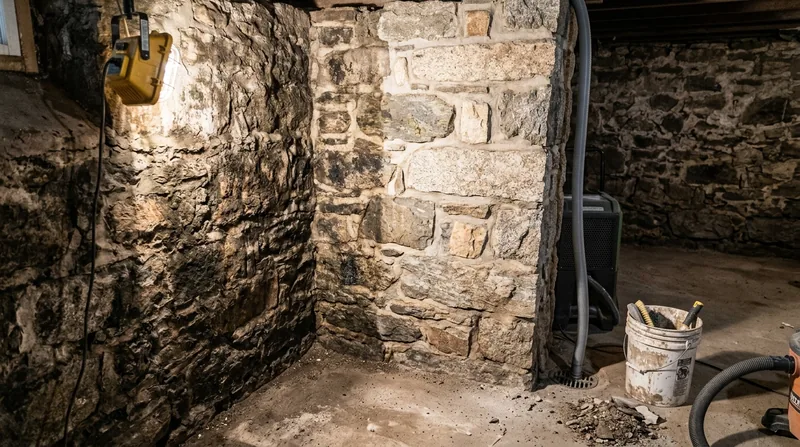




If you smell that musty, earthy odor every time you walk down the basement stairs, or you see dark fuzz along the base of the fieldstone wall in your Acre triple-decker, you are dealing with Basement Mold Remediation in Lowell. This city sits on glacial till and river outwash along the Merrimack and Concord, with a high water table in the floodplain and bedrock close to the surface on the hills. That means spring snowmelt and nor'easter rain push water hard against 1840s brick and fieldstone foundations, and the moisture that follows feeds mold growth. We fix the moisture source first, then remediate the affected surfaces so it does not come right back. Call (978) 788-0721 for a free basement inspection, or read how our basement waterproofing service stops the water at the source.
Why Mold Takes Hold in Lowell Basements
Lowell's housing stock is the perfect host for mold. Mill-era workers' housing in Centralville and Pawtucketville often has full basements on fieldstone or early block walls with old clay footing drains that have long since collapsed. Those walls weep, efflorescence blooms white on the brick, and the relative humidity stays high all summer. In the Highlands and South Lowell, 1900s two-families and bungalows have poured or block walls with hairline cracks that open a little wider every freeze-thaw cycle.
- Hydrostatic pressure pushes groundwater through mortar joints and porous brick, keeping the wall face damp.
- Failed or missing footing drains let water pool at the base of the wall instead of carrying it away.
- Sump pump failure during a spring storm leaves standing water that wicks up into framing and stored goods.
- Poor grading and short downspout extensions dump roof water right against the foundation.
- Condensation on cold masonry in humid weather keeps surfaces wet even when no leak is visible.
Any one of these is enough to support mold growth, and most Lowell basements have two or three working together.
Key info: A homeowner on a sloped street in the Belvidere section called us after a nor'easter soaked the carpet. The fieldstone wall had been damp for years, and the musty smell had spread through the first floor. We traced it to a collapsed clay footing drain and a discharge line that dumped water two feet from the wall.
Massachusetts homeowners can check contractor registration through the Office of Consumer Affairs and Business Regulation, and Lowell building permit questions go to the city's Inspectional Services Department.
How We Remediate Mold and Stop It From Returning
Remediation without moisture control is a waste of money. Our process starts with finding out why the basement is wet, not just scrubbing what is visible. We use moisture meters and a thermal camera to map damp areas behind finishes, then build a scope that addresses both the mold and the water path feeding it. The musty smell diagnostic is part of every inspection, because odor usually points to a hidden source.
- We inspect the basement, foundation walls, footing drain, sump basin, and grading to identify the moisture source.
- We set up containment with plastic sheeting and negative air pressure so spores do not spread to the living space above.
- We remove porous materials that cannot be cleaned, such as wet drywall, insulation, and saturated wood.
- We treat affected masonry and framing with an antimicrobial and HEPA-vacuum the entire area.
- We correct the water path with interior perimeter drain, sump pump replacement, crack injection, or grading changes as needed.
- We install a vapor barrier or dimple board where wall moisture is persistent, and set up dehumidification.
- We verify dryness with a final moisture reading before we close out the job.
The goal is a dry basement that stays dry through the next spring melt.
Key info: A 1920s two-family in the Highlands had mold on the lower block wall and a sump that ran constantly. We installed an interior drain tile system tied to a new primary and battery backup pump, treated the wall, and the basement has stayed dry through two springs since.
Remediation Approaches We Use in Lowell
Not every mold job is the same, and not every wet wall needs the same fix. The table below shows the main approaches we use and when each one makes sense in Lowell's older housing stock and river-floodplain neighborhoods.
| Approach | Description | Best for |
|---|---|---|
| Surface treatment and HEPA cleaning | Containment, antimicrobial treatment of masonry and framing, HEPA vacuuming of the entire area. | Light surface mold on walls and joists with a known, correctable moisture source. |
| Removal of porous materials | Cut out and dispose of wet drywall, insulation, and saturated wood that cannot be cleaned. | Finished basements with soaked drywall after a sump failure or wall seepage. |
| Drainage correction | Interior perimeter drain, footing drain repair, sump pump installation, and discharge line routing. | Recurring damp walls and floor seepage driven by hydrostatic pressure. |
| Wall sealing and vapor barrier | Crack injection, parging, dimple board, and vapor barrier to isolate damp masonry from the interior. | Fieldstone and brick walls that stay damp from efflorescence and condensation. |
| Dehumidification and ventilation | Correctly sized dehumidifier and controlled ventilation to keep relative humidity in check. | Basements that stay humid in summer even after leaks are fixed. |
We choose the lightest approach that solves the problem, and we tell you plainly when simple crack sealing is enough and when the real driver is hydrostatic pressure.
Basement Mold Remediation Cost in Lowell: What to Expect
Most basement mold remediation jobs in Lowell start around $1,500, and that figure covers containment, treatment of affected surfaces, HEPA cleaning, and a moisture check. The final number depends on how much material has to come out, how large the affected area is, and whether drainage work is needed to stop the water feeding the mold. A small area of surface mold on a block wall in a South Lowell ranch is a different job from a finished basement in Pawtucketville that took on water after a sump failure.
Factors that move the price include the square footage of affected wall and floor, whether drywall or insulation must be removed and replaced, the condition of the footing drain, and whether a new sump pump or interior drain tile is part of the fix. Access matters too: a low fieldstone basement with a narrow bulkhead takes longer to work in than a poured basement with a full stair. We recommend getting two or three written estimates so you can compare scope, not just price. Our full pricing overview breaks down how we build an estimate.
What to Look for When Hiring a Basement Mold Remediation Contractor Near Lowell
Mold remediation and waterproofing are not the same trade, and you want a contractor who understands both. Ask for proof of licensing and insurance, and get a certificate of insurance before work starts. A written scope should name the moisture source and the fix, not just the square footage to be treated. Check references from jobs in Lowell or neighboring towns with similar housing stock, and ask whether the contractor pulls permits when structural or drainage work is involved. For condominiums on the city's edges, check with your association before any work begins.
Reach out through our contact page to schedule a free estimate, or call (978) 788-0721 and we will get back to you within 24 hours.
Basement Mold Remediation in Lowell: Pricing Guide
| Service | Price | Details |
|---|---|---|
| Surface mold treatment with HEPA cleaning | Starting at $1,500 | Containment, antimicrobial treatment, HEPA vacuuming, and final moisture check included. |
| Removal of affected drywall and insulation | Starting at $2,400 | Cut-out, disposal, and re-treatment included; price rises with square footage and access difficulty. |
| Remediation plus drainage correction | On estimate | When the moisture source needs interior drain tile, sump work, or crack injection, we price after the on-site inspection. |
| Travel | Included | In Lowell and surrounding areas, no separate call-out or mileage fee. |
| Estimate | Free | Response within 24h at (978) 788-0721, no obligation to book. |
Indicative pricing, the exact cost depends on square footage, finish, and site access. Free personalized estimate within 24h at (978) 788-0721.


