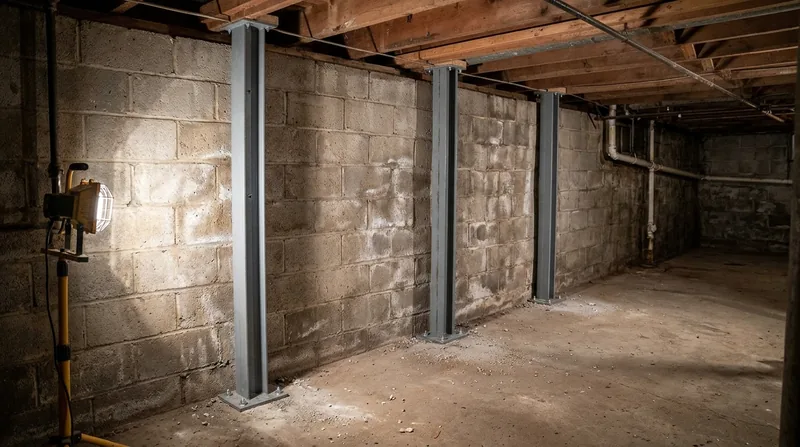




Lowell sits on glacial till and river outwash along the Merrimack and Concord, with schist and granite bedrock close to the surface on the hills and a water table that stays high in the floodplain. That means the old fieldstone, brick, and early block walls under the Acre, Centralville, Belvidere, and Pawtucketville triple-deckers have been taking saturated soil pressure for a century or more. When a wall starts to lean or bow inward, it is not a cosmetic issue, and Bowing Wall Repair in Lowell is the work that stops the movement before the wall fails. We stabilize leaning and bowing foundation walls with carbon fiber straps, steel I-beams, or wall anchors, matched to how far the wall has moved and what the soil is doing. If you have spotted a crack widening at the top of the wall or a floor joist pulling away from its pocket, call (978) 788-0721 and we will look at it. You can also read our foundation waterproofing page to understand the water side of the problem.
Why Bowing Walls Show Up in Lowell's Older Mill-Era Basements
Most of the bowing walls we see in Lowell are in houses built between the 1840s and the 1930s, where the basement wall is fieldstone laid in lime mortar or early concrete block with little or no reinforcement. Saturated glacial till pushes laterally against that wall every spring, and the freeze-thaw cycle works the joints open and closed all winter. The wall does not fail overnight; it creeps inward a fraction of an inch a year until the movement is obvious.
- Hydrostatic pressure from saturated till pushes the middle of the wall inward, which is why the bow is usually worst at mid-height.
- Old clay footing drains in the Acre and Centralville are often collapsed or root-filled, so water sits against the wall instead of draining away.
- Fieldstone walls laid without reinforcement have almost no tensile strength and lean as the mortar joints crush on the inside face.
- Downspouts that discharge within a few feet of the foundation keep the soil at the wall saturated long after the rain stops.
Any one of these can start the movement, and two or three together will accelerate it, so the fix has to address both the wall and the water pressing on it.
Key info: On a Belvidere triple-decker we inspected last spring, the fieldstone wall had bowed about 2 inches over 20 feet, and the old clay footing drain was completely silted shut. The wall anchors went in after we restored drainage, not before, because anchoring a wall that is still sitting in saturated soil just fights the pressure longer.
Structural foundation repair in Massachusetts commonly requires a building permit, and the rules vary by jurisdiction, so confirm the requirement with the Lowell building department before work starts. The state contractor registration lookup at Mass.gov is a good place to verify who you are hiring.
How We Repair a Bowing Wall in Lowell, Step by Step
We start by measuring the movement, not guessing at it. A plumb line and a laser level tell us how far the wall has traveled and whether the top, the middle, or the whole wall is moving. From there we check the soil side, the footing, and the drainage, because a wall that is anchored but still sitting in water will keep moving. Only then do we pick the method.
- We inspect the full wall, the floor joists, and the sill plate to see how far the movement has carried into the framing.
- We check the footing drain and the grading around the foundation to find out why the soil is staying wet.
- We measure the bow with a plumb line and record it, so we have a baseline to compare against later.
- We recommend carbon fiber straps for a wall that has bowed less than about 2 inches and is otherwise sound.
- We recommend steel I-beams or wall anchors when the movement is larger or the wall is block or fieldstone.
- We correct the water source with drainage work so the repair is not fighting hydrostatic pressure from day one.
The method follows the measurement, and we tell you plainly when a crack is stable enough that simple sealing is the honest answer instead of a full stabilization job.
Key info: In the Highlands, a 1920s two-family had a block wall bowing about 1.5 inches with no cracking at the corners. Carbon fiber straps on the inside face, plus a downspout extension and regrading, stabilized it without excavation. A Pawtucketville fieldstone wall with 3 inches of movement needed wall anchors driven into the outside soil and tied back to the floor framing.
If the inspection turns up active seepage at the same wall, the drainage side is handled through our interior drain tile system, which we often install in the same visit.
Matching the Repair Method to the Wall and the Soil
There is no single right answer for every bowing wall in Lowell. A poured concrete wall in a 1990s subdivision off the city edge behaves differently from a fieldstone wall in the Acre, and the soil behind them is not the same either. The table below shows how we match the method to the condition.
| Approach | Description | Best for |
|---|---|---|
| Carbon fiber straps | Straps bonded vertically to the inside face and anchored top and bottom to resist further inward movement. | Poured or block walls with less than about 2 inches of bow and no horizontal cracking. |
| Steel I-beams | Vertical steel beams set against the wall, pinned to the floor and tied to the joists above. | Block or fieldstone walls with moderate movement where the wall needs a hard stop. |
| Wall anchors | Steel plates set in the outside soil, connected by rods through the wall to inside plates. | Walls bowed 2 to 5 inches where the outside soil can be reached and the wall can be pulled back. |
| Drainage correction | Footing drain repair, regrading, and downspout extensions to cut the hydrostatic pressure at the source. | Any bowing wall in saturated glacial till, paired with the structural repair. |
| Epoxy or polyurethane injection | Resin injected through ports to close a leaking crack in a wall that has otherwise stopped moving. | Stable walls with a seeping crack, not a substitute for structural stabilization. |
The right row in that table comes from the measurement and the soil, and we will tell you when the cheaper row is the honest one.
Bowing Wall Repair Cost in Lowell: What to Expect
Pricing for bowing wall repair starts at From $600 for the smallest jobs, such as sealing a stable crack with epoxy injection and correcting the drainage that fed it. A carbon fiber strap system on a single wall typically runs into the low thousands, and wall anchors or steel I-beams on a badly bowed fieldstone wall run higher because of the excavation, the steel, and the engineering. The number moves with the length of the wall, the amount of movement, the wall material, and how much drainage work is needed alongside it.
Access is the other big variable. A wall in a Centralville basement with a bulkhead and a clear perimeter is a different job from a wall behind a finished basement or under a low mill-era joist height. We would rather give you a real number after seeing the wall than a low one over the phone. Getting two or three estimates on a structural repair is smart, and any contractor who will not put the method and the scope in writing is telling you something.
Our full pricing overview breaks down the ranges by method so you can compare bids on the same basis.
Choosing a Bowing Wall Repair Contractor Near Lowell
Structural repair attracts contractors who are really waterproofers, and waterproofing attracts contractors who are really generalists. Ask what they will actually install, how they will measure the movement, and whether they will put the method in writing before you sign. A licensed and insured contractor should hand over a certificate of insurance on request without being asked twice.
- Confirm the contractor is licensed and insured for structural foundation work in Massachusetts, and ask for the certificate.
- Get two or three written estimates that specify the method, the wall length, and the drainage work included.
- Ask for references from Lowell jobs with the same wall type, fieldstone or block, not just poured concrete.
- Ask who pulls the building permit and confirm the requirement with the Lowell building department, since thresholds vary.
- Ask whether the repair carries a transferable warranty and get the terms in writing.
A contractor who answers those questions plainly is the one you want holding the steel. Reach us through our contact page to set up an inspection.
Bowing Wall Repair Near Me: What Lowell Homeowners Should Know
When you search for bowing wall repair near me in Lowell, the results mix waterproofing specialists, foundation repair firms, and general contractors. The work itself is below grade and structural, and the diagnosis matters more than the label on the truck. A wall that has moved an inch in ten years and stopped is a different job from one that moved an inch in the last two springs.
We look at the wall, the soil, and the drainage together because that is how the movement started. If the water table is high and the footing drain is gone, anchoring the wall without fixing the water is a repair that will be tested every spring. We tell you which parts of the job are structural, which are drainage, and which can wait.
Call (978) 788-0721 for a free basement inspection, and we will measure the wall and give you a straight answer on what it needs.
Bowing Wall Repair in Lowell: Pricing Guide
| Service | Price | Details |
|---|---|---|
| Crack injection and drainage correction | Starting at $600 | Epoxy or polyurethane injection on a stable crack plus downspout and grading correction to stop the water feed. |
| Carbon fiber strap system, single wall | Starting at $1,800 | Straps bonded and anchored on a poured or block wall bowed under 2 inches, priced by wall length. |
| Steel I-beam stabilization | Starting at $3,200 | Vertical beams pinned to the floor and tied to joists, priced by beam count and basement access. |
| Wall anchor system | Starting at $4,500 | Outside anchor plates and through-wall rods for walls bowed 2 to 5 inches, priced by wall length and excavation. |
| Complex or large-scale job | On estimate | Fieldstone walls, multiple bowed walls, or finished basements need an on-site look before a number is given. |
| Estimate | Free | Free basement inspection with movement measurement, response within 24 hours at (978) 788-0721, no obligation. |
Indicative pricing, the exact cost depends on square footage, finish, and site access. Free personalized estimate within 24h at (978) 788-0721.


