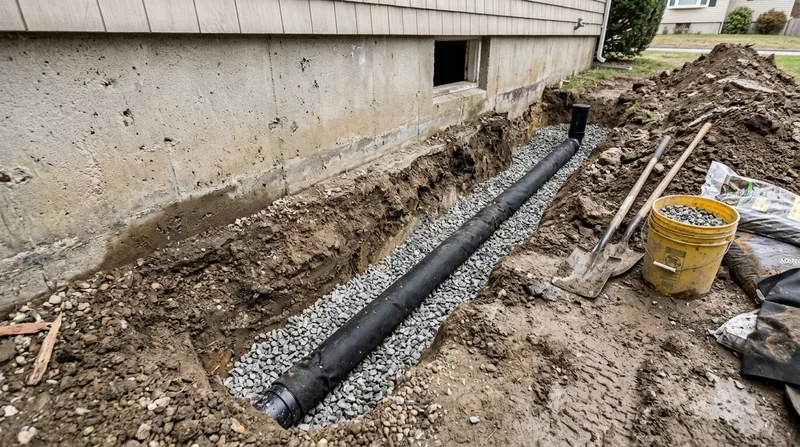




French Drain Installation in Lowell: Stop Water Before It Reaches Your Foundation
If you own an older home in the Acre, Centralville, or Pawtucketville, you already know how Lowell's spring snowmelt and nor'easter rain push water against fieldstone and brick foundations. French Drain Installation in Lowell intercepts that groundwater before it ever touches the wall. We install exterior perimeter drains along the footing, set in washed gravel and wrapped in filter fabric, then tied to daylight or a sump basin. The ground here is glacial till and river outwash sand and gravel, with schist and granite bedrock close to the surface on the hill streets. That means water moves fast and finds the path of least resistance, usually straight into your basement. We build systems that give it a better path. If you are still sorting out whether you need exterior drainage or an interior solution, start with our basement waterproofing overview for the full picture.
Why Lowell's Older Neighborhoods Need Exterior Drainage
The mill-era workers' housing and triple-deckers in the Acre and Centralville were built with clay footing drains that are now a century old and largely collapsed. The Highlands and South Lowell two-families from the 1900s to 1930s have full basements on early block walls that crack under freeze-thaw cycles every winter. Along the Merrimack and Concord rivers, the water table sits high in the floodplain, and hydrostatic pressure does the rest. A French drain relieves that pressure at the source.
- It intercepts snowmelt and storm runoff before it reaches the footing.
- It replaces failed clay weeping tile with perforated PVC and clean gravel.
- It reduces hydrostatic pressure that pushes water through block joints.
- It ties into a sump basin or discharges to daylight where grade allows.
On the sloped streets of Belvidere and Pawtucketville, a properly graded drain can move hundreds of gallons away from the house during a single spring storm.
Key info: A homeowner on a hill street in the Highlands had water entering at the footing every March. The old clay drain tile had collapsed. We replaced it with a wrapped perforated pipe and gravel bed tied to a new sump basin, and the basement stayed dry through the next snowmelt.
For official guidance on drainage and grading rules in the city, check the City of Lowell building department pages before you schedule work.
How We Install a French Drain on a Lowell Foundation
We start by walking the grade around the house and checking where water actually pools. On the river outwash streets near the Concord, that often means finding a high water table that limits how deep we can go. On bedrock hill lots, it means working around shallow granite. The process is the same either way: find the water path, intercept it, and give it somewhere to go.
- We mark the excavation line along the foundation wall and call for utility locates.
- We dig a trench to the footing, typically 12 to 18 inches wide and 18 to 24 inches deep.
- We line the trench with filter fabric to keep glacial clay soil out of the gravel.
- We set washed stone, then lay perforated PVC pipe with the holes facing down.
- We cover the pipe with more stone, wrap the fabric over the top, and backfill.
- We tie the drain to a sump basin or run it to daylight at a safe discharge point.
- We restore grading so the soil slopes away from the wall at roughly 6 inches over 10 feet.
Every installation ends with a flow test and a walkthrough so you can see where the water goes. For homes where exterior excavation is not practical, we also install interior drain tile systems that capture water at the wall base from inside.
Key info: On a 1920s two-family in South Lowell, the rear yard sloped toward the house and the downspouts dumped at the foundation. We installed a French drain along the rear wall, extended the downspouts, and regraded the yard. The owner reported no water the following spring.
French Drain Approaches We Use in Lowell
Not every yard allows the same installation. The table below shows the main approaches we use and where each one fits best in Lowell's housing stock and terrain.
| Approach | Description | Best for |
|---|---|---|
| Exterior footing drain to daylight | Perforated pipe in gravel along the footing, discharging by gravity to a lower point on the lot. | Sloped lots in Belvidere and the Highlands where grade allows gravity discharge. |
| Exterior drain to sump basin | Same trench and pipe, but water collects in a sealed basin and is pumped out. | Flat lots and river floodplain streets where daylight is not available. |
| Interior perimeter drain | Channel cut at the wall base inside the basement, leading to a sump basin. | Finished basements and homes where exterior excavation would damage mature landscaping. |
| Curtain drain on a slope | A shallow drain placed uphill of the house to intercept surface and shallow groundwater. | Homes built into hillsides in Pawtucketville and along the river bluffs. |
We choose the approach after looking at your grade, your soil, and where the water is actually coming from, not from a catalog.
French Drain Installation Cost in Lowell: What to Expect
Most exterior French drain work in Lowell starts around $25 per linear foot, with the final number driven by trench depth, soil conditions, and how far the discharge has to run. A simple run along one wall of a ranch in South Lowell sits near the low end. A full perimeter job on a triple-decker in Centralville, with bedrock close to the surface and a sump basin added, moves toward the higher end. Access matters too: a narrow side yard between two buildings takes more hand work than an open backyard.
We always recommend getting two or three written estimates so you can compare scope, pipe material, and what happens to the discharge water. For a fuller breakdown of what different drainage and waterproofing scopes run in this area, see our pricing page.
What to Look for When Hiring a French Drain Contractor Near Me in Lowell
Hiring the right contractor matters more than the pipe brand. Ask for proof of licensing and insurance before anyone digs, and get a certificate of insurance sent directly from the carrier. Get at least two written estimates that spell out trench dimensions, pipe type, gravel, fabric, and discharge location. Ask for references from jobs in Lowell or nearby Lawrence and Methuen, and call them. Confirm who pulls any required permit, since work that alters drainage or ties into a sump discharge may need one, and rules vary by jurisdiction.
If your property is in a historic district or has deed restrictions, check those before excavation. When you are ready to schedule a walkthrough, contact us and we will set up a free basement inspection.
French Drain Installation in Lowell: Pricing Guide
| Service | Price | Details |
|---|---|---|
| Exterior French drain, single wall | Starting at $25/linear ft | Includes trench, filter fabric, washed stone, perforated PVC, and backfill; depth and soil conditions move the price. |
| Full perimeter exterior drain | Starting at $35/linear ft | Covers all four walls with tie-in to sump basin or daylight; access around the foundation is the main cost driver. |
| Interior perimeter drain | Starting at $30/linear ft | Channel cut at the wall base inside the basement, gravel, and connection to sump basin; finished floors add labor. |
| Sump basin and pump add-on | Starting at $850 | Sealed basin, cast-iron or thermoplastic pump, check valve, and discharge line; pump capacity and head height affect price. |
| Complex or hillside job | On estimate | Bedrock, high water table, or tight access between buildings needs an on-site look before a number is given. |
| Estimate | Free | Response within 24 hours at (978) 788-0721, no obligation to book. |
Indicative pricing, the exact cost depends on square footage, finish, and site access. Free personalized estimate within 24h at (978) 788-0721.


