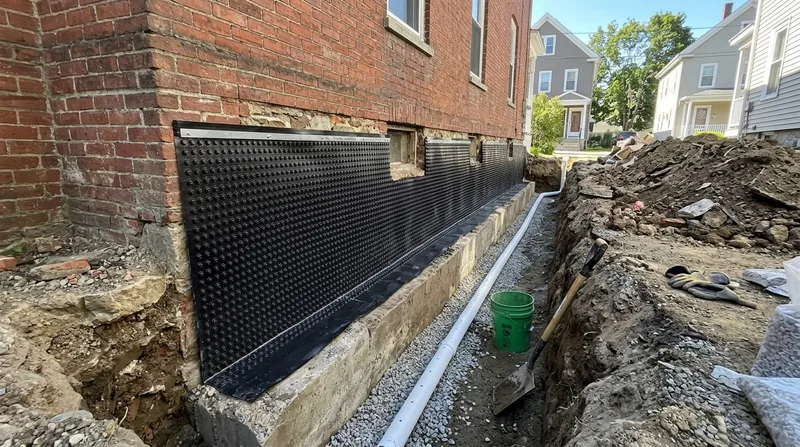




Exterior Basement Waterproofing in Lowell
If your basement takes on water every spring, Exterior Basement Waterproofing in Lowell is the fix that works from the outside in. Lowell sits on glacial till and river outwash sand and gravel, with schist and granite bedrock close to the surface on the hills and a high water table down along the Merrimack and Concord. That geology pushes water against foundation walls all year, and the freeze-thaw cycle opens the cracks a little wider every winter. In the Acre and Centralville, the old mill-era brick and frame workers' housing and triple-deckers sit on fieldstone, brick, or early block walls with clay footing drains that are a century past their service life. On the hills in Belvidere and Pawtucketville, the same water finds its way down through sandy outwash and shows up as seepage at the wall-floor joint. We excavate down to the footing, apply a waterproof membrane or dimple board directly to the wall, and correct the grading and downspouts so the water leaves the house. If you want the full picture of how exterior work fits with the other options, start with our basement waterproofing service page.
Why Exterior Basement Waterproofing Matters on Lowell's Old Mill-Era Foundations
Most of the wet basements we see in Lowell are not a crack problem. They are a hydrostatic pressure problem. The water table in the river floodplain rises every spring, and the old clay footing drains under the mill-era housing in the Acre and Centralville stopped draining decades ago. When the ground around the foundation is saturated, water pushes against the wall and finds the weakest point: a mortar joint, a hairline crack, the seam where the wall meets the footing. Exterior waterproofing is the only approach that stops that water before it reaches the wall.
- The old fieldstone and brick walls in Centralville and the Acre absorb water directly through the masonry, which is why you see efflorescence blooming white on the inside face.
- Clay footing drains under pre-1930s housing clog with silt and root intrusion, so they stop carrying water away from the footing.
- Spring snowmelt and nor'easter rain raise the water table fast, and the rivers rise with them, putting steady pressure on walls that were never designed for it.
- Freeze-thaw winters work every crack open a little more each year, so a small leak in October is a wet floor by March.
- Grading that slopes back toward the house and downspouts that dump at the foundation send roof water straight down along the wall.
When the source is outside the wall, the repair belongs outside the wall. That is the plain answer, and we will tell you when it is not.
Key info: On a 1920s two-family in the Highlands with a brick foundation and a wet wall every March, we have pulled up saturated soil, found the original clay footing drain collapsed, and rebuilt the drainage at the footing before applying membrane. That is a different job than sealing the inside of the wall, and it is the one that holds.
For the official word on what work needs a permit in this city, check the City of Lowell municipal website and confirm with the building department before any excavation that alters drainage.
How We Do Exterior Basement Waterproofing in Lowell, Step by Step
Exterior work is excavation work, and the sequence matters. We start by locating every utility line and confirming the wall construction, because a fieldstone wall in Pawtucketville and a poured wall in a 1990s subdivision on the edge of the city are two different excavations. Then we dig down to the footing, which on most Lowell homes means six to eight feet of glacial till and outwash sand. We inspect the footing drain while it is exposed, because if it is collapsed clay tile, no membrane in the world will keep that water out.
- We mark utilities and confirm the wall type and footing depth before a shovel goes in the ground.
- We excavate down to the footing and inspect the existing drain tile and the condition of the wall below grade.
- We repair or replace failed footing drain sections and tie them into a positive discharge.
- We apply a waterproof membrane or dimple board directly to the cleaned wall surface.
- We backfill with free-draining material and regrade the soil so it slopes away from the house.
- We extend downspouts well clear of the foundation and confirm the discharge point carries water away.
Every step is done with the wall exposed, so nothing is hidden behind soil when we finish.
Key info: On a 1950s ranch off outer Pawtucketville streets, the downspouts were dumping directly against the foundation and the grading had settled back toward the house over sixty years. We corrected the grade, extended the downspouts, and applied dimple board to the wall. That job did not need a full drain replacement, and we said so.
If your situation turns out to be better handled from the inside, we will tell you, and our interior drain tile system page covers that option in detail.
Exterior Waterproofing Approaches Compared
Not every wet wall in Lowell needs the same treatment. The table below lays out the approaches we use and when each one is the right call. The honest answer sometimes is that a simple crack seal is enough, and sometimes it is that the water table is the real problem and exterior work is the only fix that lasts.
| Approach | Description | Best for |
|---|---|---|
| Full exterior excavation with membrane | Dig to the footing, apply waterproof membrane or dimple board to the wall, correct drainage and grading. | Walls that seep through masonry under hydrostatic pressure, especially old fieldstone and brick in the Acre and Centralville. |
| Exterior membrane with footing drain repair | Same excavation, plus replacement of collapsed clay footing drain and a positive discharge. | Homes with original clay drain tile that no longer carries water away from the footing. |
| Grading and downspout correction only | Regrade soil away from the wall and extend downspouts clear of the foundation. | Wet basements where roof water and settled grade are the only source, common on 1950s to 1970s ranches. |
| Interior drain tile alternative | Interior perimeter drain and sump basin that relieve water at the wall-floor joint from inside. | Walls where exterior excavation is impractical, such as shared walls or tight lots, and where water enters at the cove joint. |
| Crack injection alone | Epoxy or polyurethane injection into a single active crack. | Isolated cracks with no evidence of broad hydrostatic pressure, where sealing the crack is genuinely enough. |
We will tell you which row you are in after we look at the wall, the footing, and the water table, not before.
Exterior Basement Waterproofing Cost in Lowell: What to Expect
Exterior basement waterproofing is priced by the linear foot of wall excavated, and in the Lowell market that work starts from $95 per linear foot. That figure covers excavation to the footing, membrane or dimple board application, and backfill with corrected grading. It moves up when the job is harder: deep excavation on a hillside lot in Belvidere, a fieldstone wall that needs repointing before membrane, collapsed footing drain that has to be replaced, or tight access where a machine cannot reach the wall and the digging is by hand. A typical single-wall job on a Lowell two-family lands in a range most homeowners can budget for, but the only honest number comes from looking at the wall. We do not quote exterior work over the phone.
Get two or three estimates, compare what each one actually includes, and ask whether the footing drain is being inspected or just covered back up. You can see how our pricing is structured on the full pricing page.
Exterior Basement Waterproofing Near Me: How to Choose a Contractor Near Lowell
Waterproofing is one of those trades where the low bid can cost you twice. Before you sign anything, confirm the contractor is licensed and insured in Massachusetts, ask for the certificate, and call two references from jobs in Lowell or the surrounding towns. Ask specifically whether the company does exterior excavation itself or subcontracts the digging, because the excavation is where the job succeeds or fails. Confirm who pulls any permit required for structural foundation work or for altering drainage and sump discharge, and verify the threshold with the building department, since rules vary by jurisdiction. If your property is in a historic district or has a shared wall with a neighbor, check those requirements before excavation starts.
When you are ready to have someone look at your wall, contact us for a free basement inspection and we will give you a straight answer about what the water is doing and what it will take to stop it.
Exterior Basement Waterproofing in Lowell: Pricing Guide
| Service | Price | Details |
|---|---|---|
| Exterior waterproofing, membrane only | Starting at $95/linear ft | Includes excavation to footing, membrane or dimple board, backfill, and corrected grading along the wall. |
| Exterior waterproofing with footing drain replacement | Starting at $130/linear ft | Adds replacement of collapsed clay drain tile and a positive discharge tied to a sump basin. |
| Grading and downspout correction | Starting at $1,800 | Regrade soil away from the wall and extend downspouts clear of the foundation on smaller lots. |
| Deep or hand-dug excavation | On estimate | Hillside lots in Belvidere and tight access where a machine cannot reach the wall need an on-site look. |
| Travel | Included | In Lowell and surrounding areas, no separate call-out or mileage fee. |
| Estimate | Free | Response within 24h at (978) 788-0721, no obligation to book. |
Indicative pricing, the exact cost depends on square footage, finish, and site access. Free personalized estimate within 24h at (978) 788-0721.


