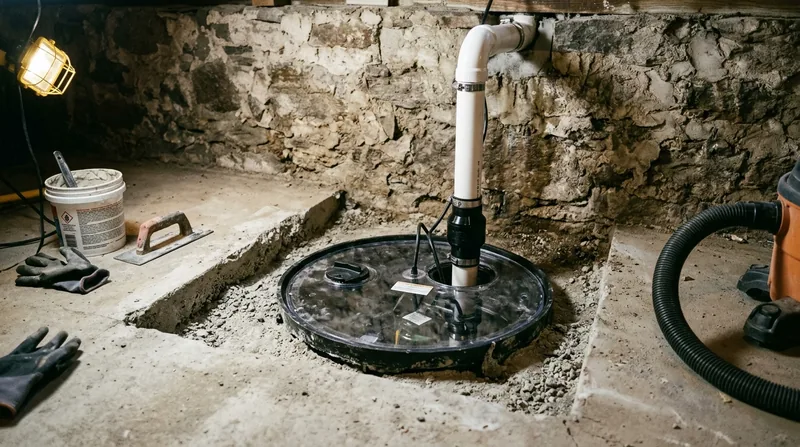




Lowell sits where the Merrimack and Concord rivers meet, and that geography defines how water behaves under the city. In the Acre and Centralville, 1840s to 1900s mill-era brick and frame workers' housing sits on fieldstone and early block foundations with old clay footing drains that have long since collapsed or silted shut. In the Highlands and South Lowell, 1900s to 1930s two-families and bungalows have full basements dug into glacial till. Out on the edges, 1980s to 2000s subdivisions have poured basements, but the water table in the river floodplain is high enough that a failed pump means a wet basement by morning. Sump Pump Installation & Replacement in Lowell is the work we do most, because a pump is the one component that turns a functioning interior perimeter drain into a dry basement. We size the pump, seal the basin, set the check valve, and route the discharge line so it survives a nor'easter and a February freeze. If your pump is short-cycling, tripping the breaker, or simply not keeping up during spring snowmelt, call (978) 788-0721 and we will look at the whole system, not just swap a box. Start with a free basement inspection and we will tell you plainly what the water is doing.
Why Sump Pump Failure Hits Lowell Basements Harder Than Most
The dominant failure mode here is hydrostatic pressure from a rising water table, not a single leaky crack. When the Merrimack and Concord rise in March and April, and again when nor'easter rain saturates the glacial till, water pushes against fieldstone and early block walls that were never designed for it. The old clay footing drains in the Acre and Pawtucketville are usually broken, so water that should have left the foundation collects at the lowest point: the sump basin. If the pump is undersized, the basin is unsealed, or the discharge line is buried in a shallow trench that freezes, the basement floods.
- An undersized pump cannot keep up with spring snowmelt and burns out its motor within a season.
- An unsealed basin lets soil gas and silt in and lets the pump lose suction as the pit fills with debris.
- A missing or failed check valve lets water drain back into the basin after every cycle, so the pump runs constantly.
- A discharge line that terminates too close to the foundation or in a shallow trench will freeze and back up in January.
- A pump with no battery backup quits during the exact storm that knocks out power in the Highlands and South Lowell.
Each of these is a fixable, specific problem, and none of them require tearing up a basement floor if the drain tile itself is still sound.
Key info: In the Acre and Centralville, we routinely find a 1/3 HP pump in a 24-inch unsealed clay pit serving a full basement under a triple-decker. That pump was adequate in 1978. It is not adequate for a saturated glacial till water table, and it is the first thing we replace.
Permits for work that alters the sanitary connection of a sump discharge vary by jurisdiction, so confirm the current requirement with the City of Lowell building department before work begins.
How We Install or Replace a Sump Pump in Lowell, Step by Step
We start by watching how the water actually arrives, not by guessing from the pit. On a recent Belvidere job, the homeowner had replaced the pump twice in three years and still got water after every storm. The pump was fine. The old cast-iron drain tile had crushed at two joints, so the basin only received water from one side of the basement. We corrected the drain tile, enlarged the basin, and set a properly sized pump with a sealed lid. That is the difference between replacing a part and solving the problem.
- We inspect the basin, the surrounding drain tile, and the discharge route, and we check the water level during and after a rain event where possible.
- We size the pump to the volume of water the foundation actually takes in, not to a generic horsepower rating.
- We set a new basin or re-set the existing one, bed it in gravel, and seal the lid to keep silt and soil gas out.
- We install a check valve on the discharge and route the line to a freeze-protected outlet, a dry well, or a gravity drain that meets local code.
- We wire the pump to a dedicated circuit with a GFCI, and we test the float switch through several full cycles before we leave.
- We walk you through the system, including how to test it monthly and what a battery backup adds during a power outage.
If the drain tile around the basin is collapsed, we handle that as part of the job through our drain tile repair and replacement service, so the new pump is not fighting a broken system.
Key info: In the river floodplain near the Concord, we often route the discharge to a dry well sized for a 100-year storm. In the hills above Pawtucketville, where bedrock is close to the surface, a gravity line to daylight is usually the better answer. The right discharge route depends on the lot, not on a standard template.
Approaches We Use for Sump Pump Installation & Replacement in Lowell
Not every basement needs the same system. A 1950s ranch on the outer streets with a partial basement and good grading may need only a reliable primary pump in a sealed basin. A triple-decker in Centralville with a full basement and a high water table usually needs a larger basin, a higher-capacity pump, and a battery backup. We match the approach to the building and the water, and we tell you when the simpler option is the correct one.
| Approach | Description | Best for |
|---|---|---|
| Primary pump replacement in existing basin | New pump, check valve, and float switch set into a sound existing basin with a sealed lid. | Basins that are intact and drain tile that still flows. |
| New basin and pump installation | Cut and set a new basin in gravel, connect to the interior perimeter drain, and install a sized pump. | Basements with no basin, or a cracked clay pit that will not seal. |
| High-capacity pump with battery backup | Larger pump paired with a battery backup sump pump on a separate discharge. | High water table in the floodplain and homes that lose power in storms. |
| Discharge line correction | Re-route a frozen or short-cycling line to a freeze-protected outlet, dry well, or gravity drain. | Pumps that run constantly or back up in winter. |
| Drain tile correction with pump | Repair crushed or silted drain tile so the basin receives water from the full perimeter. | Repeated pump failures and water entering on one side only. |
Sump Pump Installation & Replacement Cost in Lowell: What to Expect
Most homeowners in Lowell are looking at a starting point of From $1,200 for a straightforward pump replacement in a sound basin with a sealed lid and a corrected discharge line. A new basin cut into a basement floor, a high-capacity pump with a battery backup, or drain tile correction alongside the pump will move the number up, because the work and the materials both increase. The variables that matter most are the condition of the existing basin and drain tile, the pump capacity the water table requires, and how far the discharge line has to run to a freeze-protected outlet.
Getting two or three estimates is smart, and not because the lowest number wins. Ask each contractor how they sized the pump, whether they inspected the drain tile, and where the discharge will terminate in January. A quote that does not mention the discharge route is a quote that will leave you with a frozen line. Our full pricing overview breaks down the ranges so you can compare like with like.
What to Look for When Hiring a Sump Pump Contractor Near Lowell
You want a contractor who specializes in below-grade water, not a general handyman who also installs pumps. Ask for proof of licensing and insurance, and ask whether the company carries workers' compensation coverage for the crew that will be in your basement. Get at least two written estimates that specify pump capacity, basin type, check valve, discharge route, and electrical work. Ask for references from jobs in Lowell or a neighboring city with similar housing stock, and call them.
Permits are commonly required for work that alters drainage or the sanitary connection of a sump discharge, and thresholds vary by jurisdiction, so confirm with the local building department before work starts. If your home is in a condominium or a subdivision with an association, check the rules on exterior discharge before the line is routed. When you are ready, contact us and we will set up a free inspection and a written estimate with no obligation.
Sump Pump Installation & Replacement in Lowell: Pricing Guide
| Service | Price | Details |
|---|---|---|
| Pump replacement in existing basin | Starting at $1,200 | New pump, check valve, sealed lid, and discharge test in a sound existing basin. |
| New basin and pump installation | Starting at $1,850 | Cut and set new basin in gravel, connect to perimeter drain, install sized pump. |
| High-capacity pump with battery backup | Starting at $2,400 | Larger pump plus backup on separate discharge, sized for high water table. |
| Discharge line correction | Starting at $650 | Re-route frozen or short-cycling line to freeze-protected outlet or dry well. |
| Complex or large-scale job | On estimate | Drain tile correction, multiple basins, or long discharge runs need an on-site look first. |
| Estimate | Free | Response within 24h at (978) 788-0721, no obligation to book. |
Indicative pricing, the exact cost depends on square footage, finish, and site access. Free personalized estimate within 24h at (978) 788-0721.


