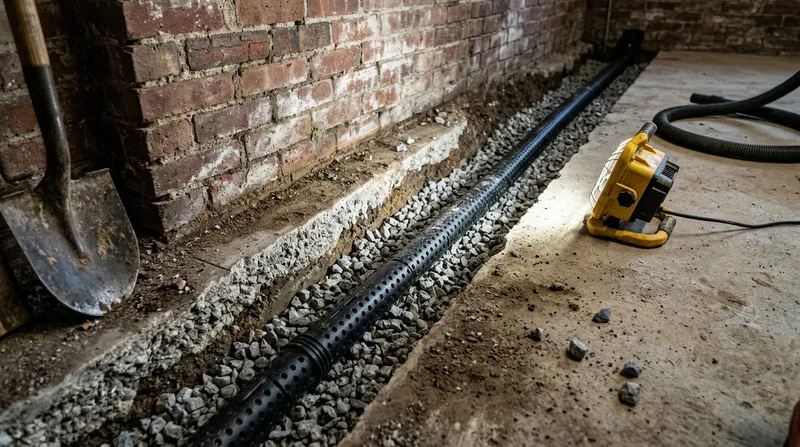




Lowell sits where the Merrimack and Concord rivers meet, and the ground under most of the city is glacial till and river outwash sand and gravel. On the hills toward Belvidere and Pawtucketville, schist and granite bedrock sit close to the surface. Down in the Acre and Centralville, the water table runs high and pushes against 1840s to 1900s fieldstone, brick, and early block foundations every spring. An Interior Drain Tile System in Lowell is the answer we install most often for that combination. We cut the slab edge, lay perforated pipe at the footing, and route the water to a sump basin that pumps it out and away from the house. It works in till and outwash soils that hold water through the thaw, and we install it in any season. If you are still sorting out whether water is coming through the wall or up through the floor, start with a basement waterproofing assessment before you commit to a system.
Why Interior Drain Tile Matters in Lowell's Mill-Era Basements
Most of the housing stock we work on in Lowell was built before sump pumps and modern footing drains existed. The old clay weeping tile around those foundations has collapsed or silted shut, and the fieldstone mortar has softened over a century of freeze-thaw cycles. When the Merrimack rises in March and April, hydrostatic pressure finds every gap. Water seeps through the cove joint where the wall meets the footing, and it wicks up through the slab. Interior drain tile intercepts that water at the lowest point instead of letting it pool on the floor.
- Spring snowmelt and nor'easter rain overload the old footing drains and push water against the walls.
- Hydrostatic pressure forces water through the cove joint and up through cracks in the slab.
- Fieldstone and early brick walls wick moisture and show efflorescence and white salt bloom.
- Clay footing drains in the Acre and Centralville are often crushed, root-filled, or silted solid.
- Freeze-thaw winters open wall cracks a little wider every year.
When the water is coming up through the floor rather than through the wall, interior drain tile is the right fix, and no amount of crack sealing will stop it.
Key info: A triple-decker off Broadway in Centralville had water across the basement floor every March. The walls were dry above the cove joint, which told us the water was rising through the slab, not leaking through the brick. Interior drain tile and a new sump basin fixed it. For the City of Lowell's permit requirements on work that alters drainage, check the City of Lowell official website and confirm with the building department before work starts.
How We Install an Interior Drain Tile System in Lowell
We start by finding where the water actually enters. That means a full walk of the basement, a look at the cove joint and the slab, and a check of the existing sump pit and discharge line. Then we lay out the perimeter run so the pipe slopes continuously to the basin. We break out the slab edge, dig down to the footing, and set the pipe in washed stone with a filter fabric wrap so till and sand cannot clog it. The concrete goes back over the top, and we test the pump before we leave.
- We inspect the basement, the cove joint, and the existing drain tile to find the water source.
- We set the sump basin at the low corner and cut the slab edge around the perimeter.
- We dig to the footing and lay perforated pipe in washed stone with filter fabric.
- We connect the pipe to the basin and install the pump with a check valve on the discharge line.
- We patch the concrete, test the system with water, and confirm the discharge runs away from the foundation.
On poured basements in the 1980s and 2000s subdivisions on the city edges, the same layout works with less digging because the slab is cleaner and the footing is uniform. For homes where the wall itself is seeping above the cove joint, we pair the drain with wall sealing or crack injection, and you can read about that on the foundation crack repair page.
Key info: A 1920s two-family in the Highlands had a partial basement with a poured floor and a fieldstone wall. The homeowner had already tried parging the wall twice. We ran interior drain tile along the two wet sides, tied it to a new sump basin, and the floor stayed dry through the next spring melt.
Interior Drain Tile Approaches We Use in Lowell
Not every basement takes the same layout. The age of the foundation, the depth of the footing, and whether the floor is poured or old brick set the approach. Here is how we match the method to the house.
| Approach | Description | Best for |
|---|---|---|
| Full perimeter interior drain | Pipe runs along all four walls to a single sump basin. | Full basements with water on multiple walls or across the floor. |
| Partial perimeter drain | Pipe runs only along the wet walls and ties into the basin. | Partial basements and homes with one wet side. |
| Drain tile plus wall sealing | Perimeter drain paired with sealing or injection at the cove joint. | Fieldstone and brick walls that seep above the floor line. |
| Drain tile plus sump upgrade | New basin and pump sized to the run, with a check valve. | Old pits that overflow or pumps that run constantly in spring. |
| Drain tile plus battery backup | Backup pump on a battery in case the power drops during a storm. | Homes that lose power during nor'easters and summer storms. |
We size the pipe and the basin to the run length and the volume the site actually takes on, not to a one-size template.
Interior Drain Tile System Cost in Lowell: What to Expect
Most interior drain tile work in Lowell starts around $50 per linear foot, and that figure includes the slab cut, excavation to the footing, perforated pipe, washed stone, filter fabric, and concrete patch. A full perimeter on a 1,000 square foot basement usually lands in the range you would expect for that much linear footage. The sump basin, pump, check valve, and discharge line are priced with the job because they are part of the system, not an add-on.
What moves the number: how deep the footing sits, whether the floor is poured concrete or old brick, how much hand digging the space allows, and whether we are also sealing a seeping wall or replacing a failed pump. A partial basement in South Lowell costs less than a full basement in Belvidere because there is less linear footage. Get two or three estimates and compare what is included, not just the bottom line. Our full pricing overview breaks down the components.
Choosing a Waterproofing Contractor Near Me in Lowell
Basement waterproofing is its own trade, separate from general foundation repair and from plumbing. Ask whether the company does this work every week or once in a while. Ask for the license and insurance certificate, and confirm the coverage is current. Ask for references from Lowell jobs, ideally in basements built like yours. Get two or three written estimates that list the pipe, stone, basin, pump, and patch separately so you can compare fairly.
- Confirm the contractor is licensed and insured and ask for the certificate.
- Get two or three written estimates with materials and labor itemized.
- Ask for references from basements of similar age and wall type.
- Ask who pulls the permit if the work alters drainage or the sump discharge connection, and verify the rule with the building department.
- Ask what happens if the system does not perform, and get the warranty terms in writing.
A contractor who will not put the scope and the warranty in writing is not the one to hire. You can reach us through the contact page to set up a free inspection.
Interior Drain Tile System in Lowell: Pricing Guide
| Service | Price | Details |
|---|---|---|
| Partial perimeter interior drain | Starting at $50/linear ft | Includes slab cut, pipe, washed stone, filter fabric, and concrete patch along the wet walls. |
| Full perimeter interior drain | Starting at $50/linear ft | Runs all four walls to one basin; total depends on basement size and footing depth. |
| Sump basin, pump, and discharge | Quoted with the job | Basin, pump, check valve, and discharge line priced together because they are part of the system. |
| Drain tile plus wall sealing | On estimate | Adds sealing or injection at the cove joint for walls that seep above the floor line. |
| Travel | Included | In Lowell and surrounding areas, no separate call-out or mileage fee. |
| Estimate | Free | Response within 24h at (978) 788-0721, no obligation to book. |
Indicative pricing, the exact cost depends on square footage, finish, and site access. Free personalized estimate within 24h at (978) 788-0721.


